
The PLACE website is not compatible with Internet Explorer. Please use a modern browser such as Chrome, Firefox, Edge, or Safari for the best experience.
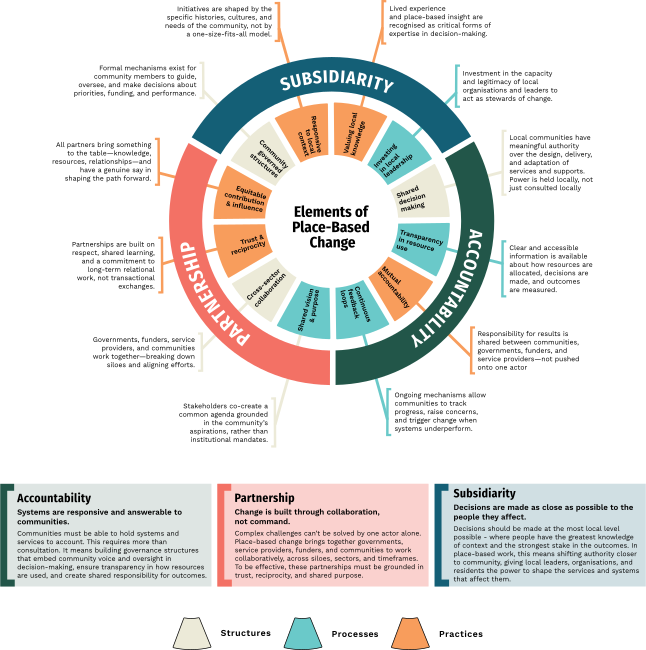
Place-based change is about working differently. The work of place-based change uses structures, processes and practices that enable and empower communities to be active participants in shaping local systems, identifying solutions and driving change on the issues that affect their lives.
This framework builds on what we heard on our Listening Tour in March–May 2025, and what we continue to learn from ongoing collaborations. The work of place-based change is defined not only by geography, but also by its governance – who gets to decide, whose knowledge counts, what is prioritised and how systems can adapt to serve people in the full complexity of their lives.
It’s this distinct approach to governance, grounded in the 3 principles of subsidiarity, accountability and partnership, that makes the work of place-based change different. In this framework, each of the 3 principles is supported by 4 elements – various enabling structures, processes and practices – all of which are interdependent and reinforcing.
Explore the 12 elements
Focus: That mechanisms exist for community members to guide, oversee and make decisions about priorities, funding and performance.
Focus: That initiatives are shaped by the specific histories, cultures and needs of the community, not by a one-size-fits-all model.
Focus: That lived experience and place-based insight are recognised as critical forms of expertise in decision-making.
Focus: That initiatives invest in the capacity and legitimacy of local organisations and leaders to act as stewards of change.
Focus: That local communities have meaningful authority over the design, delivery and adaptation of services and supports. Power is held locally, not just consulted locally.
Focus: That clear and accessible information is available about how resources are allocated, decisions are made and outcomes are measured.
Focus: That responsibility for results is shared between communities, governments, funders and service providers – not pushed onto one actor.
Focus: That ongoing mechanisms allow communities to track progress, raise concerns and trigger change when systems underperform.
Focus: That stakeholders co-create a common agenda grounded in the community’s aspirations, rather than institutional mandates.
Focus: That governments, funders, service providers and communities work together to break down siloes and align efforts.
Focus: That partnerships are built on respect, shared learning and a commitment to long-term relational work, not transactional exchanges.
Focus: That all partners bring something to the table – knowledge, resources, relationships – and have a genuine say in shaping the path forward.
To help understand how we define the terms used in this and other resources, we have created a PLACE glossary.
Alderton, A., Villanueva, K., Davern, M., Reddel, T., Lata, L. N., Moloney, S., Gooder, H., Hewitt, T., DeSilva, A., Coffey, B., McShane, I., & Cigdem-Bayram, M. (2022). What works for place-based approaches in Victoria? Part 1: A review of the literature. Victorian Department of Jobs, Precincts and Regions. https://doi.org/10.25439/rmt.19304123.v1
Australian Public Service Commission. (2025). First Nations partnerships playbook. Australian Government. https://www.apsc.gov.au/sites/default/files/2025-06/First%20Nations%20Partnerships%20Playbook%20-%20For%20publication%20-%20Accessible.pdf
Australian Research Alliance for Children and Youth. (2013). What is collaboration? https://www.aracy.org.au/wp-content/uploads/2025/04/Advancing-collaboration-practice-fact-sheets.pdf
Beer, A. (2023). The governance of place-based policies now and in the future? O.E.C.D. https://www.oecd.org/regional/place-based-policies-for-the-future.htm
Burgemeister, F. C., Crawford, S. B., Hackworth, N. J., Hokke, S., & Nicholson, J. M. (2021). Place-based approaches to improve health and development outcomes in young children: A scoping review. PLOS ONE, 16(12), e0261643. https://doi.org/10.1371/journal.pone.0261643
Carbon Neutral Cities Alliance. (2023). A community-led approach to climate justice: A case study in collaborative partnerships for climate ready and resilient communities. https://carbonneutralcities.org/wp-content/uploads/2023/08/A-Communtiy-Led-Approach-to-Climate-Justice.pdf
Centre for Public Impact. (2024). The shared power principle: How governments are changing to achieve better outcomes. BCG Foundation. https://www.centreforpublicimpact.org/wp-content/uploads/2024/10/shared-power-principle.pdf
Chaffey, H., Bruce, S., & Woods, R. (2017). Walking with communities. University of Technology Sydney. https://www.uts.edu.au/globalassets/sites/default/files/Walking_with_Communities_Report.pdf
Change Fest (2025) ChangeFest Statement. https://changefest.com.au/changefest-statement/
Children’s Ground. (2024). Evaluation of Ampe-kenhe Ahelhe Children’s Ground in Central Australia 2020 to 2022: Summary of key findings. https://childrensground.org.au/wp-content/uploads/2024/12/SUMMARY-EVALUATION-OF-AMPE-KENHE-AHELHE-2020-2022-DIGITAL.pdf
Children’s Ground. (2025). Children’s Ground: Impact report. https://childrensground.org.au/wp-content/uploads/2025/10/CG-Impact-Report-Semester-1-2025-DIGITAL.pdf
Clear Horizon. (2018). Toolkit for place-based evaluation framework. https://www.ccch.org.au/media/pidjj44h/place-based-evaluation-evaluation-framework-toolkit-final.pdf
Clear Horizon. (2020). Together in Willmot evaluation report. The Hive, Mt Druitt. https://thehivemtdruitt.com.au/wp-content/uploads/2021/08/TIW-Evaluation_FinalCH_28.4.2021.pdf
Collaboration for Impact. (2022). The language and practice of place-based and community-led change in Australia: Building a shared understanding. Platform C. https://platformc.org/sites/default/files/2022-11/CFIPlace-based%26Community-led%20changeNov22_2.pdf
Community First Development. (2025). Right way evaluation: Telling our own stories of change. https://www.communityfirstdevelopment.org.au/right-way-evaluation
Fallon, L., Pellicciotta, C., Gibney-Hughes, S., Borlagdan, J., Mallett, S., & James, S. (2024). Regional Jobs Hubs initiative: Final evaluation report. Brotherhood of St. Laurence, Social Policy and Research Centre. https://www.bsl.org.au/research/publications/regional-jobs-hubs-initiative-final-evaluation-report/
Fire to Flourish. (2024). Annual report: Our year of action, growth and impact. Monash University. https://firetoflourish.monash/__data/assets/pdf_file/0005/3932078/F2F_Annual-Report-2024.pdf
Gayde, R., Bodenstein, A., Humphries, M., Oxton-White, J., James, L., Caine, E., Holmes, R., Mitchell, R., & Vandeleur, M. (2023). Lived experience framework: Principles and practices for lived experience partnerships. Western Australian Council of Social Service. https://www.wacoss.org.au/wp-content/uploads/2023/12/WACOSS-Lived-Experience-Framework-Principles-and-Practices-for-Lived-Experience-partnerships-December-2023.pdf
Go Goldfields. (2022). Collaboration & change: An evidence-based report. Allen & Clarke Consulting. https://gogoldfields.org/wp-content/uploads/2024/11/ECEC-Change-Plan-project_Collaboration-Change-Report-1.pdf
Harris, D., Cann, R., Dakin, P., & Narayanan, S. (2023). Place-based initiatives in Australia: An overview. ARACY. https://www.aracy.org.au/wp-content/uploads/2024/09/Place-based_initatives_ARACY_report_Feb23.pdf
Health Consumers Tasmania. (2024). Closing the loop on the Health and Wellbeing Network Pilot Project – A reflection and evaluation. Health Consumers Tasmania. https://healthconsumerstas.org.au/wp-content/uploads/2024/08/HCT-Closing-the-Loop-HWN-July-2024.pdf
Hewitt, T., Arefadib, N., Gooder, H., Moloney, S., Moore, T., & Ryks, J. (2022). What works for place-based approaches in Victoria. Part 2: A review of practice. Victorian Department of Jobs, Precincts and Regions. https://cdn.jss.org.au/wp-content/uploads/2022/12/07051611/Part-2-A-review-of-practice.pdf
Howard, A., Rawsthorne, M., Sampson, D., & Katrak, M. (2020). Supporting community led approaches to disaster preparedness: Learnings from three pilot locations. Foundation for Rural & Regional Renewal; Resilience NSW; University of Sydney; University of Newcastle. https://frrr.org.au/wp-content/uploads/FRRR-DRFR-Report-Summary-FINAL-for-WEB.pdf
Inside Policy. (2023). Connected Beginnings mid-term evaluation: Final report. Australian Government Department of Education. https://www.education.gov.au/early-childhood/resources/evaluation-connected-beginnings-midterm-report-2023
Jesuit Social Services. (2024). Connecting 2770: Working to build connections to community and culture in Western Sydney. https://cdn.jss.org.au/wp-content/uploads/sites/3/2024/10/16083907/Connecting-2770-Summary-Report-Final-002.pdf
Jongsma, F., O’Connor, K., & Gregg-Rowan, C. (2024). Hands Up Mallee mid-term evaluation report. Hands Up Mallee. https://static1.squarespace.com/static/59fabd9490bcce30df85b49f/t/67e9e369c3c76251d711decb/1743381402667/1.+HUM_Mid-term+evaluation+report_Final_240912.pdf
Klepac, B., Mowle, A., Riley, T., & Craike, M. (2023). Place-based approaches: Lessons from and for Australian federal public policy. Pathways in Place, Victoria University. https://doi.org/10.26196/td5m-vv03
Lewis, J. (2023). Governance and place-based initiatives: The first steps. Early Years Partnership. https://earlyyearspartnership.org.au/wp-content/uploads/2023/01/5-Governance-Place-Based-Initiatives-PDF.pdf
Li, B., Katz, I., & Raven, M. (2025). Maranguka – A study based on publicly available evidence. ANZSOG Research Insights (Report No. 50). Australia and New Zealand School of Government. https://doi.org/10.54810/TQNJ7689
Liu, E., Lagisz, M., De Leeuw, E., & Yang, H. (2023). Place-based health interventions in NSW: A rapid review of evidence. Cancer Institute NSW; Healthy Urban Environments (HUE) Collaboratory, SPHERE. https://doi.org/10.52708/PBHI-EL
Lo, K., & Lockwood, C. (2022). Improving cross-sector collaborations in place-based population health projects. Public Health in Practice, 4, 100285. https://doi.org/10.1016/j.puhip.2022.100285
Logan Together. (2022). Logan Together annual report 2021–22. https://www.logantogether.org.au/_files/ugd/7db6a6_b57f55ca40a44fb6aeea5f4eafca3329.pdf
Logan Together Backbone Team. (2022). 1000 voices of Logan: What we’ve heard from our community. Logan Together. https://www.logantogether.org.au/files/ugd/7db6a64705ff111969403f869dcd74393b16ed.pdf
Logan Together (2022) Logan Together Roadmap 2022-2032. https://www.logantogether.org.au/roadmap
Logan Together (2022) Our Focus on Logan’s Children. https://www.logantogether.org.au/_files/ugd/494bc3_7027f75664974ae793bb9ec05cb1088c.pdf
Logan Together (2022) Three Pillars. https://www.logantogether.org.au/_files/ugd/494bc3_27c73c1729c14c71937f3d1c9c2d4a66.pdf
McDonald, M., O’Byrne, M., & Prichard, P. (2015). Using the Family Partnership Model to engage communities: Lessons from Tasmanian Child and Family Centres. Centre for Community Child Health. https://www.rch.org.au/uploadedFiles/Main/Content/ccch/150130_Using-the-Family-Partnership-Model-to-engage-communities_Report.pdf
McKenzie, F. (2019). Growing Lachlan: Community driven place-based change. Orange Compass. https://vfff.org.au/wp-content/uploads/2020/02/Growing-Lachlan-Outcomes-Report-Fiona-McKenzie-October-2019.pdf
McKenzie, F., & Cabaj, M. (2020). Changing systems, power & potential. Collaboration for Impact. https://platformc.org/sites/default/files/2020-04/Changing%20Systems%2C%20Power%20%26%20Potential%20Workshop%20Synthesis%20April%202020%20%281%29.pdf
McKenzie, F., Millar, E., Rogers, S., O’Sullivan, S., Martin, R., Machuca-Sierra, M., Enticott, Z., Barkley, E., Peterson, H., Moore, T., Fry, R., & Heery, L. (2023). Evidence for action in the early years system: Assessing system leverage points: Key findings. Orange Compass; Centre for Community Child Health; Clear Horizon; Social Enterprise Finance Australia. https://www.socialventures.org.au/wp-content/uploads/2025/05/1-of-6-E4A-Key-Findings-FINAL-May-2024-13.pdf
Opoku, S., & Matthies-Brown, K. (2024). Place-based evaluation: Collaborating to navigate learning in complex and dynamic contexts. Relationships Australia. https://www.aes.asn.au/images/images/stories/files/2024_Conference_Melbourne/aes24_Opoku.pdf
Our Place. (2023). The glue that enables place-based initiatives to work. Our Place. https://ourplace.org.au/wp-content/uploads/2023/11/ourplace-evidencepaper-theglue.pdf
Our Town. (2020). Ceduna Far West: Our Town plan. https://www.ourtownsa.com.au/file/rl4nrzhux/CedunaFar%20WestOur%20Town%20Plan.2020.pdf
Our Town. (2022). Our Town: Insights from 2022 periodic evaluation. https://www.ourtownsa.com.au/file/rlt6flcck/OT%20PE%20Insights%200902.pdf
Our Town Support Team. (2021). Our Town: Catalysing communities to lead local change. TACSI. https://www.tacsi.org.au/file/kl3jvtuod/TACSI_Our%20Town%20reflection%20report_2021.pdf
Platform C. (2020). Place-based resilience: Community driven response and recovery in a time of COVID-19. Dusseldorp Forum. https://platformc.org/sites/default/files/2020-07/Place%20based%20resilience%20report%202020.pdf
Queensland Council of Social Services. (2019). Place-based approaches for community change – QCOSS’ guide and toolkit. https://www.qcoss.org.au/wp-content/uploads/2020/06/A-summary-of-Place-based-approaches-for-community-change-QCOSS-guide-and-toolkit-Jan-2020.pdf
Ready Communities. (2025). Ready Communities whitepaper & impact: A case for regional readiness. https://www.readycommunities.com.au/ready-communities-whitepaper-impact-report/
Relationships Australia Victoria. (2024). Evaluation report: A collaborative approach to strengthening family relationships in the City of Yarra. Yarra City Council. https://www.relationshipsvictoria.org.au/media/0r2jivkd/yarra-communities-that-care-evaluation-report-strengthening-family-relationships-2024.pdf
Renando, C., Grace, K., & Woolcock, G. (2025). Reading communities white paper and impact report 2025: A case for regional readiness. Ready Communities. https://www.readycommunities.com.au/ready-communities-whitepaper-impact-report/
Rong, T., Ristevski, E., & Carroll, M. (2023). Exploring community engagement in place-based approaches in areas of poor health and disadvantage: A scoping review. Health & Place, 81, 103026. https://doi.org/10.1016/j.healthplace.2023.103026
Shakesprere, J., Mizota, M., Martinez, R., Daly, H., & Falkenburger, E. (2021). Fostering partnerships for community engagement. Urban Institute. https://www.urban.org/sites/default/files/publication/104935/fostering-partnerships-for-community-engagement_0.pdf
Simpson, K. (2021). The way forward. Collaboration for Impact. https://platformc.org/sites/default/files/spsp/SPSP-CoP-the-way-forward.pdf
Smart, J. (2019). Discovering what works for families: Needs assessment. Australian Institute of Family Studies. https://aifs.gov.au/sites/default/files/publication-documents/1902_expp_needs_assessment_0_0.pdf
Smith, S., Irving, M., Mann, G., Bjørndal, A., & Lewis, J. (2023). Evaluating place-based approaches: A review of methods used. Youth Endowment Fund; Centre for Evidence and Implementation. https://youthendowmentfund.org.uk/wp-content/uploads/2023/08/Evaluating-place-based-approaches.pdf
Spencer, M., Christie, M., & Boyle, A. (2022). Northern Territory Government local decision making ground up monitoring and evaluation final report. Northern Institute, Charles Darwin University. https://parliament.nt.gov.au/committees/previous/PAC-14th-Assembly/LDM/tabled-papers/TP-1.10-LDM-Ground-Up-Monitoring-and-Evaluation-Final-Report-August-2022.pdf
SPSP Backbone Teams with support from Collaboration for Impact. (2022). Disrupting disadvantage: Early evidence of the impact of community-led change. https://static1.squarespace.com/static/59fabd9490bcce30df85b49f/t/63772d275f80ce5a62e6dd9b/1668754748102/SPSP+Early+Evidence+Impact+Report_20221101+FINAL.pdf
Strengthening Communities. (2023). Strengthening communities position paper. Jesuit Social Services. https://cdn.jss.org.au/wp-content/uploads/2023/09/18101814/Strengthening-Communities-Position-Paper.pdf
SVA Consulting. (2023). Sustaining social infrastructure. SVA Consulting; Greater Shepparton Lighthouse Project. https://www.gslp.com.au/wp-content/uploads/SVA_Evaluation_2023_Web.pdf
Tan, W., McMahon, T., Nguyen, T., Goggin, G., & Thohari, S. (2025). Insights on refugees with disability in Australia: Foundations for belonging. Settlement Services International; Institute for Culture and Society, Western Sydney University. https://www.ssi.org.au/wp-content/uploads/2025/09/Foundations_for_Belonging_2025_Disability_Full_Report.pdf
ten20, Logan Together, Go Goldfields, Connecting Community for Kids, The Hive, Sanderson Alliance, Maranguka Community Hub, Social Ventures Australia, & The Australian Centre for Social Innovation. (2019). Funding community-led, place-based practice: Insights and actions for funders and communities. https://www.thecentrehki.com.au/wp-content/uploads/2020/03/Funding-community-led-place-based-practice-report.pdf
The National Literacy Trust. (2020). The effectiveness of place-based programmes and campaigns in improving outcomes for children: A literature review. National Literacy Trust. https://nlt.hacdn.org/media/documents/The_effectiveness_of_place-based_programmes_and_campaigns_in_improving_outcome_vdAaYu8.pdf
Thornton, D., Bryant, D., & Mallett, S. (2018). Making the leap: A practical guide to inter-agency collaboration. Brotherhood of St. Laurence. https://library.bsl.org.au/bsljspui/bitstream/1/10274/2/Making_the_Leap_practical_guide_to_inter-agency_collaboration_2018.pdf
Tomorrow Today. (2022). Education Benalla program. Tomorrow Today Education Program. https://tomorrowtoday.com.au/wp-content/uploads/2022/11/TT-EBP-10-Yr-Publication-SP.pdf
Victorian Council of Social Services. (2016). Communities taking power: Using place-based approaches to deliver local solutions to poverty and disadvantage. https://vcoss.org.au/wp-content/uploads/2018/06/CommunitiesTakingPowerFINALWebUpload.pdf
Victorian State Services Authority. (2022). Boundary spanning to improve community outcomes: A report on joined-up government. https://www.vic.gov.au/sites/default/files/2023-03/boundary-spanning-to-improve-community-outcomes-report.pdf
Walden, I., Bos, A., Rogers, B., & Werbeloff, L. (2024). Fire to Flourish: Lessons learned in its activation – Summary report. Fire to Flourish. https://firetoflourish.monash/__data/assets/pdf_file/0003/3700452/F2F-Lessons-Learned-in-its-Activation-Summary-Report_FINAL.pdf
Winangali. (2017). Stronger communities for children: Evaluation report. National Indigenous Australians Agency. https://www.niaa.gov.au/sites/default/files/documents/publications/scfc-evaluation-report.pdf
Wyndham City Council. (2021). Resilient Wyndham 2021–2025. Wyndham City Council. https://www.wyndham.vic.gov.au/sites/default/files/2021-07/Wyndham%20City%20Resilient%20Wyndham%202021-2025.pdf
Zanus, S. (2022). Building the foundation for lifelong learning: An analysis of early childhood service provision and quality in Logan. Pathways in Place, Griffith University. https://www.griffith.edu.au/__data/assets/pdf_file/0020/2192600/pip-griffith-research-report-analysis-early-learning-service-provision-logan.pdf
Download the 12 elements of place-based change diagram below in your preferred format:
In practice examples
Burnie City Council and Burnie Works – from facilitation to community ownership
Burnie Works, in north-west Tasmania, began as a Burnie City council-led local renewal effort that deliberately transitioned toward community-led governance. The council established a local enabling group to bring community members, services and government partners together under a collective impact framework. The council shifted from leading to facilitating, providing coordination and policy alignment while enabling the community to define priorities and guide action. This approach built trust, political support and legitimacy for shared decision-making.
By 2023–24, Burnie Works’ governance had evolved into a fully community-owned structure. A new membership model and cross-community working groups now ensure residents, families and partners directly shape decisions. Recognising that earlier approaches missed some voices, Burnie Works adopted deliberate outreach to engage ‘new faces and different voices’, listening for ‘the quietest voices’ in the community. This commitment to inclusion has deepened legitimacy and sustained locally led renewal.
Pingelly Community Resource Centre – responding to local context
Pingelly Community Resource Centre is located approximately 150 kilometres southeast of Perth. It is an independent not-for-profit organisation established in 1999.It is one of a network of around 150 similar organisations in WA, connected through their peak association Linkwest. These Centres are hubs for activities, services and supports, each providing community facilities and a coordination role in their town or suburb.
Pingelly Community Resource Centre shows how responding to local context works in practice. The centre is community-led and governed by local people. Its role is to listen, connect, and respond to what matters most to the people of Pingelly. Services and activities are tailored to suit local needs and aspirations, including digital skills training, supporting community groups, and coordinating projects that facilitate local connection.
The Staying in Place – Virtual Village was led from the Pingelly Community Resource Centre with the Pingelly Somerset Alliance. Local residents identified a clear problem where older people were having to leave town to access aged care. In response, the centre helped design a ‘village without walls’, using local contractors and volunteers, and technology, to support seniors to remain in their homes and community. The model builds on local strengths – neighbours looking out for each other, small-town trust, and strong relationships – and adapts as needs change.
Pingelly Community Resource Centre also played a key role in shaping the Pingelly Community Wellbeing Plan 2024–2027, which was developed through workshops, surveys and community conversations. This process ensured that priorities like mental health, safety, and inclusion were based on what residents said they needed most. By continually listening, testing ideas, and adjusting how services are delivered, the centre shows how being context responsive leads to better-fit, stronger relationships, and lasting local impact.
The structure of the Staying in Place model has been implemented by similar local hub organisations across WA and into other states. The framework remains the same, but the shape of delivery, nature of partnerships, range of activities and ways of working differ in each location, as each local context informs the local response that is required.
Jarjum Centre – Aboriginal self-determination in action
Jarjum Centre is an early childhood centre for Aboriginal children in Lismore, New South Wales, on the lands of the Widjabal Wiyabal people within the Bundjalung Nation. The centre was established 40 years ago through the work of dedicated Elders.
Jarjum Centre embodies Aboriginal self-determination in action. Rather than adapting mainstream models, it was designed from the ground up by Aboriginal community members drawing on cultural strengths, kinship networks, and holistic understandings of child and family wellbeing. The term ‘jarjum’ itself (meaning ‘child’ in Bundjalung language) reflects the centre’s commitment to language revitalisation and cultural identity.
By integrating Elders’ knowledge, cultural practices and connection to Country into everyday operations, Jarjum Centre creates a culturally safe environment where Aboriginal families can access services without compromising their identity or values. This includes incorporating Sorry Business protocols, recognising extended kinship responsibilities, and ensuring staff reflect the community they serve.
Indi Kindi – anchoring early childhood education in local knowledge
Moriarty Foundation’s Indi Kindi, is a community co-designed early childhood program operating in Borroloola and Tennant Creek, Northern Territory.
Indi Kindi shows how Aboriginal knowledge and community expertise can shape effective, culturally-grounded early learning. The program was born of community, anchored in knowledge and accepted through trust. Design and governance was guided by Law women (elders), families, and local educators who hold deep cultural and linguistic expertise.
All educators are local Aboriginal women who are qualified or undertaking study toward early childhood education qualifications, a majority exceeding 6 years tenure. Their lived experience, language and cultural knowledge are formally recognised and remunerated. The program’s Walking Learning® curriculum takes place outdoors and on Country, combining Aboriginal and Western approaches to child development and supporting strong cultural identity and connection to place and aligning with the Australian Early Years Learning Framework.
Guided by a community advisory group of elders and Traditional Custodians, Indi Kindi ensures decisions are made locally and cultural authority remains within community control and intellectual property management follows best practice.
Wunan – investing in local leadership and governance skills
Wunan is a not-for-profit Aboriginal organisation based in the East Kimberley region of Western Australia. Its purpose is to ensure that Aboriginal people in the East Kimberley enjoy the capabilities and opportunities they need to make positive choices that lead to independent and fulfilling lives.
Wunan’s approach is exemplified through two complementary initiatives. The Governance and Leadership Program builds the capacity of emerging and established leaders across Aboriginal Community-Controlled Organisations (ACCOs) and enterprises. Through accredited qualifications, mentoring and practical governance support, the program strengthens accountability, decision-making, and organisational effectiveness, ensuring Aboriginal leaders are equipped to influence decisions that shape their communities.
The Journey to Empowerment program creates clear pathways for Aboriginal people to build skills, gain employment, and strengthen their capacity to lead change within their families and communities. By combining training, employment and cultural leadership, it builds self-reliance, belonging, and economic independence. Together, these initiatives demonstrate how investing in Aboriginal leadership at both organisational and individual levels strengthens place-based decision-making and community-led development across the East Kimberley.
Fire to Flourish – strengthening local leadership capacity
Fire to Flourish is a long-term community impact program, led by Monash University, providing direct support to communities as the first and last responders to disasters.
In communities across New South Wales and Victoria recovering from the Black Summer bushfires of 2019–20, Fire to Flourish, supported by Monash University, employed trusted residents, many Aboriginal, as community leads and facilitators. They were chosen for their relationships and cultural authority rather than formal qualifications. Once recruited, they received training in facilitation, governance, disaster resilience and cultural safety to strengthen their capability. Governance processes, codes of conduct and mentoring provided the protection and authority they needed to make and support transparent decisions, while navigating local politics. With resources to design projects, manage budgets and direct local grants, communities felt capable and confident to lead recovery on their own terms.
By embedding Aboriginal knowledge and leadership throughout, Fire to Flourish turned local confidence and cultural wisdom into lasting systems change – showing that when leadership is locally held, resilience becomes self-sustaining.
Children’s Ground – enabling community decision-making
Established in 2011 by First Nations Elders, and operating in Central Australia and the Top End, Children’s Ground gives local communities genuine control over decision-making. Its dual governance system balances cultural and corporate structures: cultural governance committees in both regions, made up entirely of First Nations members, provide local and national leadership, ensuring cultural integrity and local decision making; while the corporate board – with over half First Nations directors – oversees broader operational decision making under Western governance requirements. The chair and CEO report jointly to both, reflecting equal authority.
This structure ensures decision making is collective, place-based and locally led, while non-Indigenous partners work within, not above, community-led systems. Elders and emerging leaders from diverse language groups are able to embed cultural knowledge and leadership in every decision. Programs are planned and reviewed through both First Nations and Western frameworks, keeping accountability close to home. Over the years, this model has built deep trust and ownership, with First Nations participation in governance increasing significantly and pathways opening for emerging leaders to step into decision-making roles and carry cultural authority into the future.
Flemington Works – reshaping what is possible through shared decision-making
Flemington Works is a place-based initiative built around a co-design model that positioned local residents as decision-makers. Facilitated by Moonee Valley City Council and supported by the Victorian Government’s Community Revitalisation Program, co-design groups—one for women and one for young people living on the Flemington Housing Estate—were established as formal mechanisms guiding shared decision-making in practice. Community members were employed as Project Support Officers, which recognised their lived experience as expertise and ensuring their time and contributions were remunerated.
Through a series of structured workshops facilitated by the Council and Clear Horizon, community members defined local priorities, identified barriers to employment, and co-created strategies and evaluation frameworks. Meetings included training in systems thinking, root-cause analysis, and data interpretation, enabling residents to participate confidently in complex decision-making. The design of meetings was itself co-created—interpreters, visual tools, and shared cultural practices ensured inclusivity and accessibility.
These enabling structures—paid roles, training, inclusive facilitation, and forma co-design groups—embedded community authority within governance processes and shifted how government and service partners worked with the local community. Flemington Works highlights what becomes possible when power and decision-making responsibilities are effectively shared.
Greater Shepparton Lighthouse Project – using transparent approaches to resource use
The Greater Shepparton Lighthouse Project is a place-based initiative in Victoria that works to ensure all young people in the region can reach their full potential and thrive. It uses research, data, local insights and lived experience to inform decision-making and create locally tailored responses.
Flexible funding from government and philanthropic partners, paired with participatory approaches, enables the Shepparton community to shape priorities and guide how resources are directed. This occurs through the Greater Shepparton Lighthouse Project’s ‘Head, Heart and Hands’ principles, which embed community voice in decision-making via the project’s ‘1000 Conversations’ consultations, local community leaders, and the community-owned Seer Data & Analytics dashboard.
The Greater Shepparton Lighthouse Project remains transparent to funders through detailed annual plans, expenditure reports, and ongoing dialogue about progress. This structured accountability builds the trust and confidence that sustain flexible funding and long-term community and partner engagement.
Learning the Macleay – embedding community participation to ensure transparency
Learning the Macleay is a place-based initiative on the mid-north coast of New South Wales. It aims to build on the community’s strengths to create better futures for children and families through locally tailored, evidence-informed solutions.
From the outset, the initiative has embedded community representation within its governance to ensure transparency, trust and accountability. Its Community Reference Table, comprising local service providers, Aboriginal communitycontrolled organisations, non-government agencies, education providers and local government, oversees the work of the backbone organisation. This group plays a critical role in making decision-making visible: information and insights gathered from the community are shared back through members’ organisations to drive change.
Wyndham City Council – embedding community perspectives and priorities
Wyndham City Council, in the outer southwestern suburbs of Melbourne, Victoria, embedded community priorities from the Wyndham 2040 Community Vision into its broader 2021–2025 Council Plan. This means community priorities such as social connection, food security, sustainability and disaster readiness have been integrated across council units, action plans and yearly targets. Council staff also attend community-led events, such as My Smart Garden and Café Connect, to directly engage with residents to understand needs and progress, which then informs the council’s annual reports, which are made public. Wyndham City Council also integrates ‘Most Significant Change’ methods into the evaluation process to glean community perspectives. Through integrating community priorities into a whole-of-council approach, the council is able to foster collective accountability for community goals.
Regional Jobs Hubs Initiative in Tasmania – a state-led, community-driven model
The Regional Jobs Hubs Initiative in Tasmania is a state-led, community-driven model that connects 7 regional hubs through a coordinated statewide network. Each hub is governed by advisory boards that include employers, training providers, community organisations and local government to ensure that diverse community perspectives are represented. These boards identify regional priorities related to employment and training opportunities, which are shared through the network, coordinated by Jobs Tasmania.
The network supports exchange between hubs to identify systemic barriers and translate local learning into policy advice at a state level – creating continuous feedback loops between community and government. This process has enabled community priorities and insights to directly shape major statewide programs, policies, and reforms, including the Tasmanian Skills Plan, transport programs, economic development and the state’s first Youth Jobs Strategy. Together, the hubs function as a collective system actor, aligning government, industry and community around shared priorities and regional opportunities.
Gladstone Region Engaging in Action Together – translating community feedback into action
The Gladstone Region engaging in action Together (GRT) initiative facilitates community-led, place-based social change that improves wellbeing for children, families and the broader Gladstone region of Queensland through early intervention, improved access to services, and community-driven solutions. It is part of the Stronger Places, Stronger People initiative, supported by the Australian and Queensland governments.
A shared wellbeing action plan and measurement framework have helped drive Gladstone’s comprehensive approach to translating community insights and feedback into action. At the heart of this work is a community-built and owned Wellbeing Data Hub, which holds over 400 datasets, combining community stories, local research and service insights. Community events, an ongoing schedule of community conversations, and surveys and feedback mechanisms make participation easy and ongoing. Insights gathered feed into topic-based working groups that co-design local responses, while a dedicated data and evaluation group tracks the impact of these actions on community wellbeing.
What has made GRT effective is its commitment to genuine feedback loops, turning data and community voice into shared decisions and visible outcomes – growing local ownership of Gladstone’s wellbeing journey.
The Hive Mt Druitt – integrating community feedback into advocacy for better transport
The Hive Mt Druitt (United Way Australia) is based in Western Sydney, New South Wales, and is the backbone organisation for the Collective Impact initiative ‘Together in 2770’ comprised of local organisations and community members. The Hive’s overarching goal is for all children to start school well, with equal opportunity to learn, be healthy and participate in quality community life.
The integration of community voice at all stages of the Collective’s advocacy initiatives has been key to centering community across all stages.
Based on feedback received through The Hive’s measurement, evaluation and learning (MEL) system, including qualitative methods such as Impact Yarns, and Linger, Listen and Learn, it was identified that poor public transportation was significantly affecting community access to services and opportunities. The Collective organized a community transport forum, which was attended by Transport for NSW and Blacktown City Council, allowed community members to directly share their experiences and challenges with those accountable for the changes, resulting in opportunities for those to work with the community to improve transportation in the area.
The loop of collecting feedback to utilising it, and creating opportunities for the community, ensures their concerns raised with the Collective are taken seriously and has been an essential part of strengthening trust with the community.
Strengthening Family Relationships – Yarra
Strengthening Family Relationships – Yarra is a community-led coalition in the City of Yarra, Victoria, involving more than a dozen local agencies working together to support children and young people aged 8 to 14. Developed from the earlier Communities That Care Yarra coalition, the initiative builds on that foundation by bringing together partner agencies and local schools to collaborate with a shared vision and purpose. Supported by a backbone organisation, it is guided by reviews of existing data, a youth survey and community consultations, identifying both risk factors as well as protective factors within the community that can be leveraged. The continued engagement of these stakeholders in the implementation of programs and facilitation roles reinforces the collective purpose and alignment with community priorities throughout the initiative.
As noted by one of the facilitators in the 2024 evaluation report, ‘When we do work together with other stakeholders towards a shared goal, we are able to get better outcomes for the young people and families we work with.’
Logan Together – engaging community to co-create a shared vision and purpose
Logan Together is a community-movement in the City of Logan, Southeast Queensland, committed to the wellbeing of every child (ages 0-8) so that “Logan’s children are happy and healthy now and for generations to come.”
The initiative brings together a diverse group of people including residents, businesses, community organisations and government agencies, to work on common goals, tackle issues, and celebrate successes together.
Logan Together’s shared vision and purpose has evolved through an iterative process of community engagement, co-design, and community-led governance. The place-based initiative’s rests on principles articulated in the 2018 ChangeFest Statement, which called for power and responsibility to be shifted to the local community. This statement was codified through the Community Leadership Statement and supported by the 1000 Voices project undertaken in 2022. The Roadmap for Impact. The Collective Plan and the Three Pillars (First Nations first, children at the heart, and community led) sustain this purpose in everyday practice. The Gnirigomindala Karulbo (First Nations leadership and governance group) and Leadership Table (community and cross-sectors governance group) ensure the shared vision remains community-led and continually renewed through dialogue and trust.
Deep listening, community governance and codified commitments have allowed Logan Together to sustain a shared vision across a large and diverse community. Developing a shared vision and purpose has rebalanced power through First Nations and community-led governance, strengthened trust and relationships across different stakeholders involved in the initiative, and allowed partners to work together to support the children of Logan.
Go Goldfields – bringing together community, services and government
Go Goldfields brings together community members, businesses, service organisations and decision-makers to improve outcomes for children and families in Central Goldfields, Victoria. Go Goldfields demonstrates how cross-sector collaboration can drive community-led change.
Operating as a place-based partnership between state and local government, service providers and the Central Goldfields community, it is anchored by a backbone team that coordinates responses across portfolios, facilitates partnerships, and ensures accountability through shared outcomes. The Leadership Table is chaired independently and comprises senior executives, community members, and representatives from government departments. It is a formal space where collaborative, place-based decision-making takes place with community at the table.
Relationships are at the heart of Go Goldfields’ social ecological model, which aligns the system, service organisation, community and family through shared accountability and collective learning. Collaborative action is visible through initiatives like The Nest and Every Child, Every Chance, where government, service providers and community co-design and deliver solutions. Effective cross-sector collaboration has made it possible to build an integrated, responsive early-years system in the Central Goldfields that connects families, services and government around a shared vision for every child to thrive
Child and Family Learning Centres – using a relational model to build trust and reciprocity
Tasmania’s Child and Family Learning Centres (CFLCs) partner with families and communities to improve the health, wellbeing and learning of children from pregnancy to 5 years. The CFLCs use a Family Partnership Model to work with communities and local families. This relational model has been central to the design, implementation and delivery of CFLCs across Tasmania.
When the Tasmanian CFLCs were first established, staff used the Family Partnership Model (FPM) to reframe how government, services and parents worked together in partnerships. One facilitator explained how the models is ‘founded upon a respect for and encouragement of the expertise and self-determination of parents.’ Simple practices such as arranging the chairs in a circle facilitated equitable contribution and helped to build trust.
The FPM’s relational principles are embedded through ‘working together agreements’ that are co-written by parents and practitioners as a ‘touchstone’ for outlining expectations, handling conflict and guiding respectful communication. These agreements formalise reciprocity by ensuring parents, service providers, and CFC staff can go back to them when things don’t go well.
Joint FPM training sessions helped to foster mutual learning. Through this process, parents developed the confidence to speak up and feel that service providers were listening to them and valuing their input. Trust was never assumed but continually negotiated and strengthened through a cycle of reflection and review that supports joint discovery, learning and change. Establishing and sustaining trust allowed parents and communities who had been historically disengaged to take part as equal partners in service design and decision-making.
Hands Up Mallee – sustaining a culture of mutual respect
Hands Up Mallee (HUM) is a community-led, place-based initiative based in the Mildura local government area on Latji Latji country in Northwest Victoria. The initiative is working to create a connected community where children and young people thrive, and families matter.
Hands Up Mallee builds trust through authentic, relational engagement and maintains reciprocity through shared decision-making and ongoing collaboration. The 2024 Mid-Term Evaluation highlights the link between HUM’s expertise, care and intentionality when engaging with community and the trust placed in HUM by community members. Engagement practices position community members’ lived knowledge, data, research evidence and service provider understanding as equally valid sources of knowledge. One parent described what this reciprocity meant: “It was respect and I remember [the HUM Team] was always saying, ‘Oh, you’re the experts'”. HUM can operate as a connector, explained a service provider, because they’ve got the rapport with community, with kids, with agencies, and they can make a phone call to get people on board quickly. Programs like HomeBase Hoops have translated these principles into practice through co-creating relaxed spaces where young people and service providers, including police and Youth Justice staff, connect as equals. Through relational practices and structural mechanisms, HUM sustains a culture of mutual respect and shared responsibility.
Ending Rough Sleeping Collaboration Byron Shire – distributing power and influence widely
The Ending Rough Sleeping Collaboration Byron Shire is the first community-led, place-based initiative in regional New South Wales that aims to end homelessness in the local area, starting with rough sleeping.
The Collaboration demonstrates equitable contribution and influence by distributing decision-making power across partners, valuing lived experience expertise, and listening deeply to community voices to shape local action. It is a partnership model where contribution looks like a shared commitment, contextual knowledge, and collaboration across different roles. At the heart of the Collaboration is a backbone team, hosted and co-funded by Byron Shire Council. Instead of acting as a ‘traditional’ lead agency, the council’s role via the backbone team is to support and enable the collective efforts of the Collaboration, including helping shape a shared agenda for change, facilitating inclusive community engagement, and supporting research and advocacy.
Influence is distributed through a collaborative governance group (known as the Local Leaders Group) that includes homelessness services and housing providers, neighbourhood hubs, community and grassroots organisations, not-for profits, and community members. This group is resourced and supported by the backbone team to shape direction and strategy. Lived experience consultants on the Local Leaders Group further ensure that people with lived and living experience of homelessness guide the shared work. These mechanisms ensure knowledge, lived experience and evidence drives solutions and that influence is community-led.
Resources to support place-based change
These resources are here to support PBIs and those working with them to implement practices identified in the 12 elements. They come from a mix of sources from Australia and globally. It is not a comprehensive list and will grow with time and through collaboration. We see this as a starting point. If you would like to contribute resources, feel free to get in touch.
There is no one-size-fits all model for place-based governance. Depending on the local context, vision and maturity of a PBI, it can vary in formality, leadership, authority and representation.
Governance structures are a mechanism through which decisions can be shaped with communities rather than for them, strengthening buy-in and ownership of the initiatives.
These guidance documents on collaborative governance can be used to identify which structures might best suit your context. They outline considerations, processes, roles and responsibilities. Additionally, Culture Smart Governance explore how governance can be linked to support self-determination and cultural principles when working with First Nations communities.
- Collaborative Governance: An introductory practice guide
Publisher: Collaboration for Impact
Year published: 2020 - Collaborative Governance Framework
Publisher: Tamarack Institute
Year published: 2017 - Governance Principles in Practice [videos]
Publisher: Queensland Council of Social Service
Year published: 2023 - Culture-Smart Governance
Publisher: Australian Indigenous Governance Institute
Year published: 2023
Communities are not homogeneous. Lived experience and cultural knowledge are key to ensuring place-based initiatives are responsive to context and should be recognised as a specific expertise.
The history and experience of marginalised groups, such as Refugees, First Nations or homeless communities, can shape how they will engage and perceive different stakeholders.
These frameworks and tools help you better understand how to create safe and inclusive processes and practices when working with different populations, including adaptations and considerations you may need to think about when designing programs and community engagement strategies.
- NSW Settlement Strategy: Refugee Lived Experience Framework
Publisher: Multicultural NSW
Year published: 2024 - A Toolkit to Authentically Embed Lived Experience Governance
Publisher: Lived Experience Leadership and Advocacy Network (LELAN)
Year published: 2023 - NCOSS Lived Experience Framework
Publisher: NSW Council of Social Service (NCOSS)
Year published: 2021 - Deep Democracy – Perspectivity
Publisher: Perspectivity Collective
Year Published: 2020 - Rise Module (interactive e-learning)
Publisher: NSW Aboriginal Land Council
Year Published: 2024
Working with multiple partners is part of place-based work. To develop tailored cross-sector plans that build on shared vision and purpose, it is critical to understand who should be involved, who holds influence and who can be potential barriers to change.
Stakeholder analysis should be regularly reviewed and updated to account for changes in purpose and actors. It can be done within an organisation or across multiple partners.
These tools give some suggestions on how to identify, disaggregate and prioritise stakeholders.
- Conducting a Social Network Analysis
Publisher: Converge Network
Year published: 2023 - Social Network Analysis Project Toolkit
Publisher: Thriving Queensland Kids Partnership
Year published: 2025 - Wheels of Engagement
Publisher: Tamarack Institute
Year Published: 2017
Partnerships and collaborations are a fundamental aspect of place-based change. As they are often established in the early stages of an initiative, it is important to clarify guiding principles, expectations and accountability mechanisms. This helps sustain partnerships as well as institutionalise them so that they are not dependent on individual will. Partnerships and collaborations should be revisited at regular intervals to ensure they are fit for purpose.
These tools provide guidance on types of collaborations, the different stages and the structures and practices you can use to formalise them.
- The Intersector Project Toolkit
Publisher: The Intersector Project
Year Published: 2014 - Network Toolkit
Publisher: Converge Network
Year Published: 2024 - Collaborative Practice Models
Publisher: Community Door
Year Published: 2020 - Collaboration Health Assessment Tool
Publisher: Centre for Social Impact and Collaboration for Impact
Year Published: 2017 - Creating Change through Partnerships
Publisher: SNAICC – National Voice for Our Children
Year published: 2020 - Advancing Collaboration Practice Fact Sheets
Publisher: Australian Research Alliance for Children and Youth (ARACY)
Year published: 2013 - How to Prepare for Conversations that Broker Difference
Publisher: Platform C and Collaboration for Impact
Year published: 2020 - Thriving Queensland Kids Partnerships Charter
Publisher: Thriving Queensland Kids Partnership and ARACY
Year published: 2024 - Building Partnerships with CALD Organisations
Publisher: Multicultural NSW
Year published: 2022 - The Australian Public Service Framework for Engagement and Participation
Publisher: Commonwealth Government
Year Published: 2020
Trust underpins all aspects of place-based change. Without trust between the community and the various stakeholders, interventions are unlikely to be successful.
Trust while hard to describe is something that can be built through consistent and transparent practices that demonstrate the link between action and intent.
These guides provide practical tips on the principles required to build trust, drawing on examples from different communities.
The policy paper on ‘Making government finance make sense’ looks at the specific area of participatory budgeting and ways to make resourcing more transparent.
- Mini Guide 5: Building Relationships and Trust
Publisher: Office for Youth – Australian Government Department of Education
Year published: 2024 - Trust-Building Success: Tips for Engaging Local Communities
Publisher: Rythm Foundation
Year published: 2024 - Making Government Finances Make Sense for Communities
Publisher: M Flanagan and M Miller-Dawkins
Year published: 2025 - Listen Deeply Practice Kit
Publisher: Qld Government
Year Published: 2023
A shared vision and purpose built on community priorities supports effective place based change.
These tools look at different strategies for gathering community voice, and how to bring these insights together into shared vision and purpose.
- Finding Shared Vision – Place-Based Approaches for Community Change
Publisher: Queensland Council of Social Service
Year published: 2019 - Collecting 1,000 Voices – A Collective Impact Approach
Publisher: CMM Social Change
Year published: 2021 - Community Conversations: Data and Insights Hub
Publisher: The Shoebox Enterprises and Norwich City Council Year published: 2025
Community engagement is integral to all aspects of place-based change. It supports inclusion, trust, quality and sustainability of interventions. The level of community engagement though, may differ depend on the stage, maturity and activity of PBI.
These guides discuss different types of engagement (based on IAP2), developing community engagement strategies, and concepts/tools for fostering community engagement.
- What is Collective Impact?
Publisher: Collective Impact Forum
Year published: 2022 - Community Engagement 101: Ultimate Beginner’s Guide
Publisher: Visible Network Labs
Year published: 2023 - Community Engagement Toolkit
Publisher: Collective Impact Forum and Leading Inside Out
Year published: 2017 - Understanding community-led approaches to community change
Publisher: Tamarak Institute
Year Published: 2020 - Learning activities selection Guide
Publisher: FSG- Reimaging social change - Centring equity and place-based approaches in systemic transformation
Publisher: Inspired Communities, Tamarak Institute, Place Matters and Collaboration for Impact
Year Published: 2023
Place-based change moves away from deficit models to embrace the strengths of community, and their contribution to finding solutions.
Using a strengths based approach can help draw out the valuable resources of communities (often not visible) to find solutions to complex challenges.
These mapping tools share ways to identify community strengths and map them to support desired outcomes.
- SOAR: Strengths, Opportunities, Aspirations, Results [worksheet]
Publisher: National Alliance of State and Territorial AIDS Directors (NASTAD)
Year published: 2021 - Tools for Agency-Led Asset Mapping with Communities
Publisher: Institute of Museum and Library Services
Year published: 2022 - Appreciative inquiry | Better Evaluation
Publisher: Better Evaluation Knowledge
Year Published: 2021 - Capacity building Assessment tool
Publisher: Menzies school of health research
Year: 2014
Co-design with the community makes services and programs more responsive to context, accessible and effective.
It is a distinct process. These tools help with the steps to set up spaces that foster co-design and enable different partners to meaningfully contribute.
- Co-Design Toolkit
Publisher: Agency for Clinical Innovation
Year Published: 2016 - IDEO- Co-creation session
Publisher: IDEO - Kimberly Co-Design Guide for youth wellbeing initiatives
Publisher: Kimberly Aboriginal Land and Cultural Centre
Year published: 2022